
Yarn count describes how fine or coarse a yarn is. It is one of the details that helps a fabric buyer understand a construction, compare quotations and communicate with a spinning mill. But a number such as 30s is incomplete unless the counting system is clear: 30 Ne and 30 Nm are not the same yarn size.
This guide explains the main yarn-count systems, shows practical conversion formulas, and highlights the details buyers should confirm before approving a woven-fabric specification.
What does yarn count measure?
Yarn count expresses yarn fineness or linear density. Some systems describe how much a known length of yarn weighs; others describe how much length is contained in a known mass. It does not directly measure yarn strength, fibre quality, evenness or fabric quality. Those properties also depend on fibre characteristics, spinning method, twist, yarn structure and processing.
The main yarn-count systems
English cotton count (Ne)
Ne is an indirect count system commonly used for spun cotton yarn. It is based on the number of 840-yard hanks that weigh one pound. Because it is an indirect system, a higher Ne number means a finer yarn. For example, 40 Ne is finer than 20 Ne when both refer to the same English cotton-count basis.
Metric count (Nm)
Nm is also an indirect system. It expresses the number of metres of yarn in one gram (equivalently, kilometres per kilogram). A higher Nm number means a finer yarn. Always state Nm explicitly rather than writing only a number followed by an unclear “s”.
Tex
Tex is a direct linear-density system: one tex means one gram per 1,000 metres of yarn. A higher tex value means a coarser or heavier yarn. ISO 1144 describes the Tex System as a universal way to express linear density for textile fibres, intermediate products and yarns.
Decitex (dtex)
Dtex is another direct system. One dtex means one gram per 10,000 metres. It is often used for man-made filament yarns and fibres. Ten dtex equals one tex.
Denier (D)
Denier is the mass in grams of 9,000 metres of yarn. It is widely used for continuous-filament yarns such as polyester and nylon. A higher denier means a coarser yarn. One denier equals one ninth of a tex, so denier is nine times the tex value.
Indirect and direct systems: which way does the number move?
- Indirect systems — Ne and Nm: a higher number means a finer yarn because more length fits into the same mass.
- Direct systems — tex, dtex and denier: a higher number means a coarser yarn because more mass is contained in a fixed length.
This difference is a common source of quotation errors. Do not compare two yarn-count numbers until you know which system each supplier has used.
Yarn-count conversion formulas
For single yarns, the following formulas provide useful approximate conversions. Keep the original count system in the purchase specification, even when you add a converted value for comparison.
- Ne to tex: tex = 590.54 ÷ Ne
- Tex to Ne: Ne = 590.54 ÷ tex
- Nm to tex: tex = 1,000 ÷ Nm
- Tex to Nm: Nm = 1,000 ÷ tex
- Tex to denier: denier = tex × 9
- Tex to dtex: dtex = tex × 10
- Ne to Nm: Nm ≈ Ne × 1.693
The Ne conversion uses the English cotton-count basis of 840-yard hanks per pound. Values below are rounded for practical comparison; they are not test results or acceptance tolerances.
Convert denier to Ne, Nm, tex and dtex
Denier is a direct linear-density unit: it states the mass in grams of 9,000 metres of yarn. For a single yarn, the main conversion relationships are:
- Tex = denier ÷ 9
- Dtex = denier × 10 ÷ 9
- Nm equivalent = 9,000 ÷ denier
- Ne cotton-count equivalent = 5,314.87 ÷ denier
For example, 100D is approximately 11.11 tex and 53.15 Ne equivalent. A 150D yarn is about 16.67 tex and 35.43 Ne equivalent. The table gives rounded values for several common filament-yarn deniers.
| Denier | Tex | Dtex | Nm equivalent | Ne equivalent* |
|---|---|---|---|---|
| 75D | 8.33 | 83.33 | 120.00 | 70.86 |
| 100D | 11.11 | 111.11 | 90.00 | 53.15 |
| 150D | 16.67 | 166.67 | 60.00 | 35.43 |
| 300D | 33.33 | 333.33 | 30.00 | 17.72 |
*Ne is the English cotton-count system. The Ne figures here are mathematical equivalents for comparing linear density; polyester and nylon filament yarns are normally specified in denier or dtex, not Ne. Do not rewrite a filament-yarn purchase specification in Ne unless the buyer and supplier have explicitly agreed to that convention. These calculations describe nominal linear density and do not account for ply, twist contraction, moisture regain or test tolerance.
The conversion relationships are consistent with the tables in ASTM D2260-24, which ASTM lists as active and last updated on 9 September 2024. ISO 1144:2016, the Tex System standard, remains current after ISO confirmed it on 29 December 2021.
Quick conversion table for common cotton counts
| English cotton count (Ne) | Metric count (Nm) | Tex | Denier |
|---|---|---|---|
| 20 Ne | 33.9 | 29.5 | 266 |
| 24 Ne | 40.6 | 24.6 | 221 |
| 30 Ne | 50.8 | 19.7 | 177 |
| 40 Ne | 67.7 | 14.8 | 133 |
| 50 Ne | 84.7 | 11.8 | 106 |
Worked example: why 30 Ne is not 30 Nm
A 30 Ne single yarn converts to approximately 19.7 tex. A 30 Nm yarn converts to approximately 33.3 tex. The two yarns therefore have different linear densities, even though both are labelled with the number 30. In this example, the 30 Nm yarn has about 69% more mass per unit length than the 30 Ne yarn.
When comparing offers, ask the supplier to write the full count system and, where helpful, the tex equivalent. Do not change the agreed specification simply because a converted number looks familiar.
How to read plied-yarn and filament-yarn notation
A notation such as 30/2
A notation such as 30/2 commonly means two single yarns of 30 Ne each have been plied together. On that basis, the assembled yarn has roughly twice the linear density of one 30 Ne single, or about 39.4 tex, before allowing for twist contraction and differences in conditioning or test procedure. Notation can vary between suppliers and markets, so confirm whether the quoted count refers to each single component or the finished plied yarn.
A notation such as 150D/48F
For a filament yarn, 150D/48F commonly indicates a total nominal yarn linear density of 150 denier made up of 48 filaments. The 48F is the filament count; it does not mean 150 denier for each filament. Confirm the supplier’s notation, filament type and whether the value is total denier or per filament before comparing offers.
How yarn count appears in a woven-fabric specification
A woven-fabric line may show something like 45 × 45 / 110 × 76. In a common convention, the first pair refers to warp and weft yarn counts, while the second pair refers to ends per inch and picks per inch. However, a shorthand line is not a complete specification unless the count system and density units are stated.
For a clear RFQ, write the details separately, for example:
- Warp yarn: 45 Ne, single yarn (confirm fibre composition and spinning type).
- Weft yarn: 45 Ne, single yarn (confirm fibre composition and spinning type).
- Construction: 110 ends per inch × 76 picks per inch, if that is the agreed unit.
- Other fabric details: weave, target GSM, finished and cuttable width, colour, finish and agreed tolerances.
This is an illustration of how to write a specification, not a recommended construction for every fabric. The suitable yarn count and density depend on the intended garment, performance requirements and mill capability. See our guides to warp and weft density and fabric GSM calculation for related checks.
What buyers should confirm before placing an order
- State the count system: Ne, Nm, tex, dtex or denier.
- Identify warp and weft counts separately.
- Confirm whether the yarn is single, folded or plied, and state the number of plies.
- For filament yarn, state total denier or dtex and the number of filaments.
- Record fibre composition and the required yarn construction or spinning type.
- Specify ends and picks, including whether the density is per inch or per centimetre.
- Agree the sampling, conditioning, test method, reporting basis and acceptance tolerance with the supplier.
- Compare the approved yarn or fabric sample with the final bulk lot, not only the quotation description.
For a complete buyer enquiry, use our fabric RFQ checklist. If the planned yarn is cotton, our cotton fibre quality guide explains why fibre characteristics also matter when selecting a count.
How is yarn count checked?
For yarn supplied in packages, ISO 2060 describes determination of linear density by the skein method and covers single, folded and cabled yarns within its scope. The preparation and conditioning procedure should be agreed and followed consistently.
ASTM D1059 covers yarn number based on short-length specimens. ASTM describes the result as an approximation and states that the method is not recommended for acceptance testing. If a count result will decide whether a commercial lot passes or fails, agree a suitable test method and sampling plan with the buyer and supplier before testing.
Yarn removed from finished fabric may not give exactly the same result as the original package yarn because weaving or knitting, finishing and specimen removal can affect the measured value. A test report should identify the method and the material condition tested.
Common yarn-count mistakes
- Writing “30s” without saying whether it is Ne or Nm.
- Assuming a higher number always means a finer yarn.
- Comparing a single yarn with a plied yarn as if they were identical.
- Confusing filament count (F) with denier (D).
- Assuming yarn count alone determines fabric GSM, strength or quality.
- Using a short-length approximate result as the only basis for commercial acceptance.
Key takeaway
Yarn count is useful only when its system and construction are clear. State the count system, warp and weft values, ply or filament details, density units and test basis in the same specification. This makes supplier quotations easier to compare and reduces avoidable misunderstandings during sampling and bulk production.
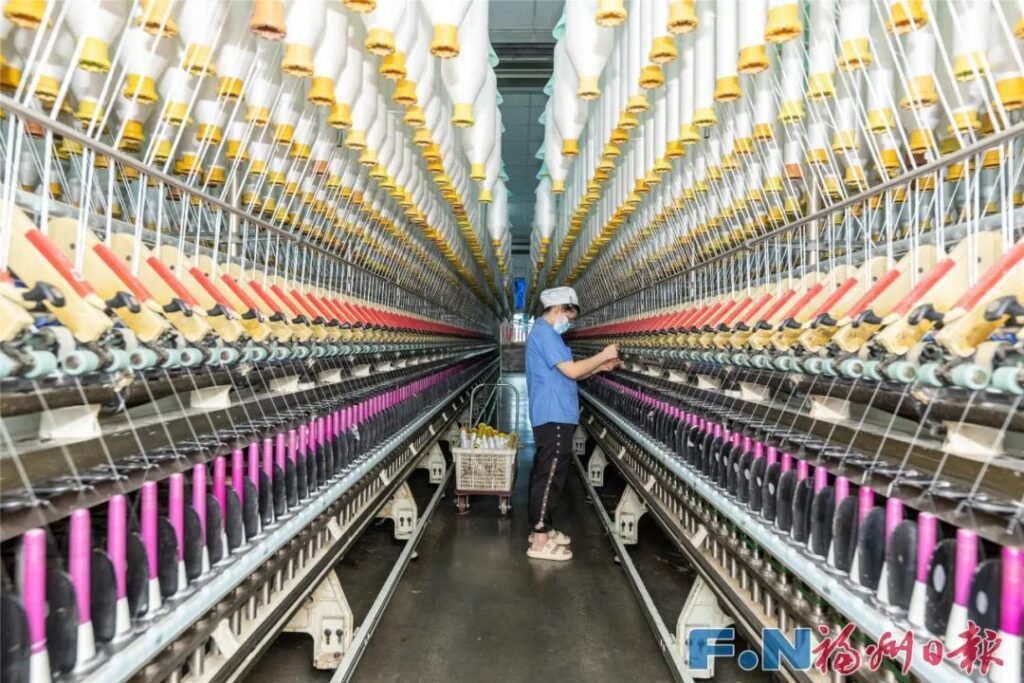
Image note: the featured image is illustrative only; it does not establish the yarn count, fibre composition or test result of any material.
Technical references
- ISO 1144:2016 — Textiles: Universal system for designating linear density (Tex System).
- ASTM D2260-24 — Standard Tables of Conversion Factors and Equivalent Yarn Numbers Measured in Various Numbering Systems (active edition).
- ISO 2060:1994 — Yarn from packages: determination of linear density by the skein method.
- ASTM D1059-17(2022) — Standard Test Method for Yarn Number Based on Short-Length Specimens.