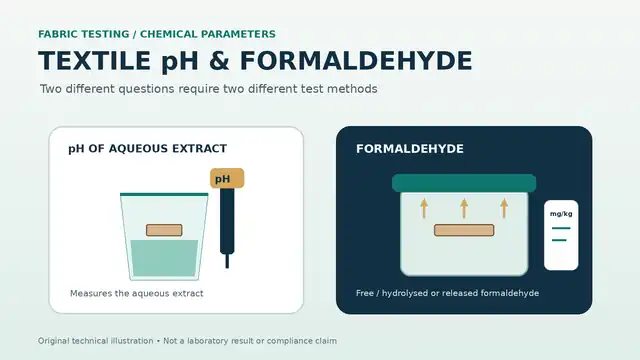
Textile pH and formaldehyde are separate chemical checks. A pH test measures the pH of an aqueous extract prepared from the textile. A formaldehyde test measures a defined amount or release of formaldehyde using a specified method. Passing one test does not prove compliance with the other.
For a meaningful result, the buyer must identify the correct method, sample, product category and acceptance limit before the laboratory begins testing.
1. What ISO 3071 measures
ISO 3071:2020 specifies a method for determining the pH of the aqueous extract of textiles. The result relates to the extract prepared under the method; it is not a direct measurement of the fabric surface and does not establish one universal pass range for every textile product.
Processing, washing and finishing can influence the pH of an extract. Buyers should therefore state the required product limit in the applicable brand specification, contract or market requirement rather than assuming the test standard itself supplies a universal acceptance value.
2. ISO 14184-1 and ISO 14184-2 are different
| Method | Approach | Measurement focus |
|---|---|---|
| ISO 14184-1:2011 | Water extraction | Free formaldehyde and formaldehyde partly released through hydrolysis under the method. |
| ISO 14184-2:2011 | Vapour absorption | Formaldehyde released from the textile under the method’s specified conditions. |
These methods are not interchangeable. If a buyer writes only “formaldehyde test”, ask whether Part 1 or Part 2 is required. The choice should come from the buyer’s specification and the product’s intended use.
3. Understand “not detectable”
A laboratory may report “ND”, “not detected” or “not detectable”. Read that statement together with the method and its reporting or detection limit. For the editions discussed here, ISO 14184-1:2011 has a lower limit of 16 mg/kg and ISO 14184-2:2011 has a lower limit of 20 mg/kg; below the relevant limit, the result is reported as “not detectable” under that method. This does not mean the substance is absolutely zero. These method limits are not buyer acceptance limits or universal legal limits; confirm the required limit and reporting basis with the buyer and laboratory.
The method’s lower reporting range is not automatically the buyer’s legal or brand limit. If the required acceptance limit is lower than the laboratory’s reporting capability, agree a suitable method with the laboratory before submitting the sample.
4. Keep the sample traceable
The test sample should represent the material being approved. Record the fabric code, composition, construction, colour, finish, supplier, lot or roll reference and sampling date. If different colours or finishes use different chemical processes, do not assume one sample represents every colour unless the buyer’s sampling plan allows it.
State whether the test is required on the material as received or after a defined washing or conditioning procedure. Do not let the laboratory guess the sample preparation or apply an unapproved wash procedure.
5. What to put in the laboratory request
- Identify the exact fabric or garment sample and production lot.
- Specify ISO 3071:2020 for pH unless another method is required.
- For formaldehyde, choose ISO 14184-1 or ISO 14184-2 explicitly.
- Write the buyer’s actual acceptance limit and identify the relevant product category and source document.
- State the sample condition and any required pre-treatment.
- Request the method and edition, result, unit, reporting limit, test date and any deviation.
- Use a buyer-approved laboratory and verify that the specific test is within its accredited scope when accreditation is required.
- Agree how borderline results, retests and conflicting reports will be handled.
6. How to check a test report
First match the sample description to the approved material. A correct result on the wrong colour, finish or lot does not establish the performance of the bulk goods under review.
Next, check the method. For formaldehyde, Part 1 and Part 2 measure different things. Confirm the reported units and read any ND statement with the reporting limit. Finally, check that the pass/fail decision uses the buyer’s correct limit for the relevant product category. ISO 3071 and ISO 14184 describe test methods; they do not set one universal acceptance threshold for every market and product.
7. Common mistakes
- Assuming a pH result also confirms formaldehyde compliance.
- Requesting “ISO 14184” without specifying Part 1 or Part 2.
- Treating “not detectable” as absolute zero.
- Using a method reporting limit as the buyer’s acceptance limit.
- Applying a limit from a different product category or market without checking the current requirement.
- Testing a sample that cannot be traced to the bulk colour, finish or lot.
- Checking only a laboratory logo instead of confirming the relevant test is within its accredited scope.
8. Example wording for a buyer’s test request
“Determine textile pH using ISO 3071:2020. Determine formaldehyde using [ISO 14184-1:2011 / ISO 14184-2:2011] as specified by the buyer. Identify the submitted material and production lot. Report the exact method, result, unit, reporting limit and any deviation. Assess the result against the attached buyer acceptance criterion.”
Select the formaldehyde method that matches the buyer’s requirement and attach the relevant restricted-substance specification. Do not leave the laboratory to choose the method or acceptance limit.
Related reading
- RSL versus MRSL in textile chemical compliance
- How to read a textile test report
- Textile pH testing methods
Standards are copyrighted documents. This article is a practical buyer overview, not a replacement for the full standard, applicable law or the buyer’s approved test protocol.