Air permeability describes how readily air passes through a fabric under specified test conditions. It matters when selecting shirt fabrics, uniforms, workwear, sportswear, filters and protective materials. A test result is useful only when the method, pressure difference, test area and reporting unit are known. A number without those conditions is not a reliable basis for comparing suppliers.
Air permeability is not the same as water-vapour transmission, moisture management or water resistance. A fabric can allow air to pass through while still having a different performance against water vapour or liquid water.
What does an air permeability test measure?
The test measures the flow of air passing perpendicularly through a defined area of a fabric while a specified pressure difference is maintained across the specimen. The result therefore depends on both the fabric and the conditions used by the test method.
Laboratories may report results in units such as millimetres per second (mm/s), litres per square metre per second [L/(m²·s)] or other method-specific units. One useful unit relationship is:
1 mm/s = 1 L/(m²·s). This follows because an air velocity of 1 mm/s through 1 m² is a volume flow of 0.001 m³/s, or 1 litre per second. Always check the unit printed on the laboratory report before comparing results.
ISO 9237 and ASTM D737: which method should buyers specify?
| Method | What it covers | Buyer point |
|---|---|---|
| ISO 9237:1995 | Determination of the permeability of fabrics to air. Its scope includes most fabric types, technical industrial fabrics, nonwovens and permeable made-up textile articles. | Specify the test area, pressure difference and any product-specific conditions required by the contract. |
| ASTM D737 | Measurement of air permeability for most textile fabrics, including woven, knitted, nonwoven, layered and pile fabrics, and fabrics that may be coated or otherwise treated. | State the edition agreed with the laboratory and buyer, together with the pressure differential and reporting unit. |
ISO lists ISO 9237:1995 as published and confirmed in 2023. ASTM lists D737-18 as an active version with a 2023 reapproval. These are separate methods. Do not assume that a result from one method is directly interchangeable with a result from the other simply because both are called air-permeability tests. The test head, pressure setting, specimen area, clamping arrangement and reporting conventions can affect the measured value.
How the laboratory test works
- Prepare representative specimens. Samples should represent the production fabric and be handled without stretching, creasing or otherwise changing the material.
- Condition the material. The laboratory follows the atmosphere and conditioning requirements of the agreed method or the buyer’s specification.
- Clamp the specimen. The fabric is secured over a test head of a defined area. The operator must prevent air leaking around the edges and avoid distorting the sample.
- Apply the specified pressure difference. Air is drawn or driven through the specimen while the apparatus maintains the agreed pressure drop.
- Record the airflow. The instrument measures the flow through the test area. The laboratory repeats the measurement at the agreed number of locations and reports the results.
This is a method overview, not a substitute for the full standard or the laboratory’s validated procedure. The exact specimen preparation, apparatus settings and number of measurements must follow the selected edition.
What can change the result?
- Fabric construction: weave or knit structure, yarn spacing, cover, thickness and yarn geometry influence the available paths for air.
- Yarn characteristics: yarn size, twist, hairiness and packing can affect the size and continuity of openings in the structure.
- Finishing: coatings, resin treatments, sizing, calendaring and other finishing processes may change airflow through the fabric.
- Specimen handling: stretching, wrinkles, edge leakage, incorrect clamping or testing near a selvage can make a result unrepresentative.
- Test conditions: changing the pressure difference, test area, face tested or conditioning can change the reported value.
- Washing and use: if the garment will be washed or otherwise treated, buyers may need a separate agreed test after that process.
Does higher air permeability always mean a better fabric?
No. Higher air permeability means more air passes through the specimen under the stated test conditions. It may be desirable in some warm-weather garments, ventilation panels or filtration applications. Lower airflow may be preferred where wind resistance, warmth or a barrier function is important.
For clothing comfort, airflow is only one part of performance. Water-vapour resistance is a different property. ISO 11092:2026 specifies measurement of thermal and water-vapour resistance using a sweating guarded-hotplate method. That test is not interchangeable with ISO 9237 or ASTM D737. For rainwear or protective clothing, buyers may also need separate tests for liquid-water resistance and other protective requirements.
What should a fabric buyer put in the specification?
Use a complete requirement rather than writing only “breathable fabric”. A purchase specification should state:
- the agreed method and edition, such as ISO 9237:1995 or the agreed edition of ASTM D737;
- the required result and unit, including whether the requirement is a minimum, maximum or range;
- the test pressure difference and test area;
- which fabric face is to be tested, where face direction matters;
- the conditioning and specimen preparation requirements;
- whether testing is required before or after a defined laundering or finishing process;
- the number of specimens and how the average and variation will be evaluated;
- the acceptance limit and the action required if the result is outside that limit.
Example wording: “Air permeability: minimum [agreed value] [unit], tested to [agreed standard and edition] at [agreed pressure difference] using a [agreed test area]. State the tested fabric face, conditioning, number of specimens, individual results and average. If post-laundering performance is required, test after the separately agreed wash procedure.”
The bracketed values must be set by the buyer and product team. There is no single pass value suitable for every fabric, garment or end use.
Questions to ask before approving a report
- Does the report identify the exact standard and edition?
- Are the pressure difference, test area and unit shown?
- Does the sample identification match the production lot and fabric finish?
- Were the specimens tested without edge leakage or visible distortion?
- Are individual readings and the average available, rather than only one unexplained number?
- Does the acceptance limit match the approved buyer specification?
For related buyer checks, see our CVC fabric guide, fabric GSM calculation guide and fabric RFQ checklist.
Official references
- ISO 9237:1995 — Textiles: Determination of the permeability of fabrics to air.
- ASTM D737-18 (2023 reapproval) — Standard Test Method for Air Permeability of Textile Fabrics.
- ISO 11092:2026 — Measurement of thermal and water-vapour resistance.
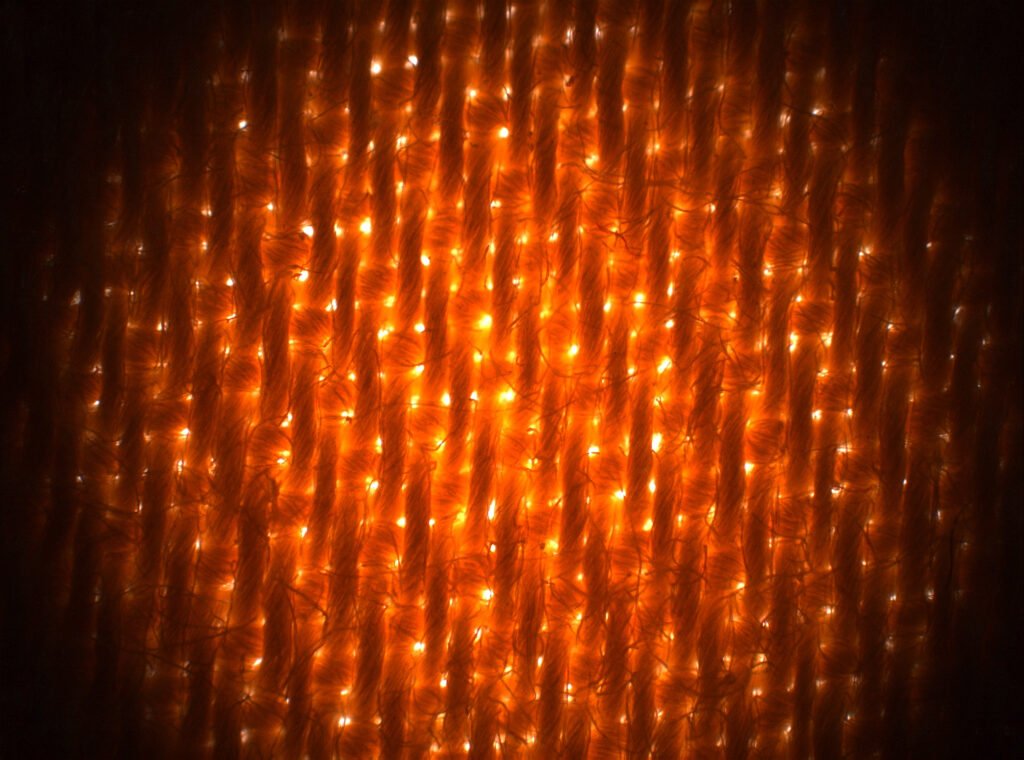
Image credit: Backlit yellow textile sample by Svasile, Wikimedia Commons, licensed under CC BY-SA 4.0. The photograph illustrates fabric porosity; it is not a laboratory test result.