A textile fiber burn test is sometimes used as a preliminary screening check because different fiber families can behave differently when exposed to heat. However, the test has important limitations. It should be treated as a screening step—not proof of the exact fiber name or percentage.
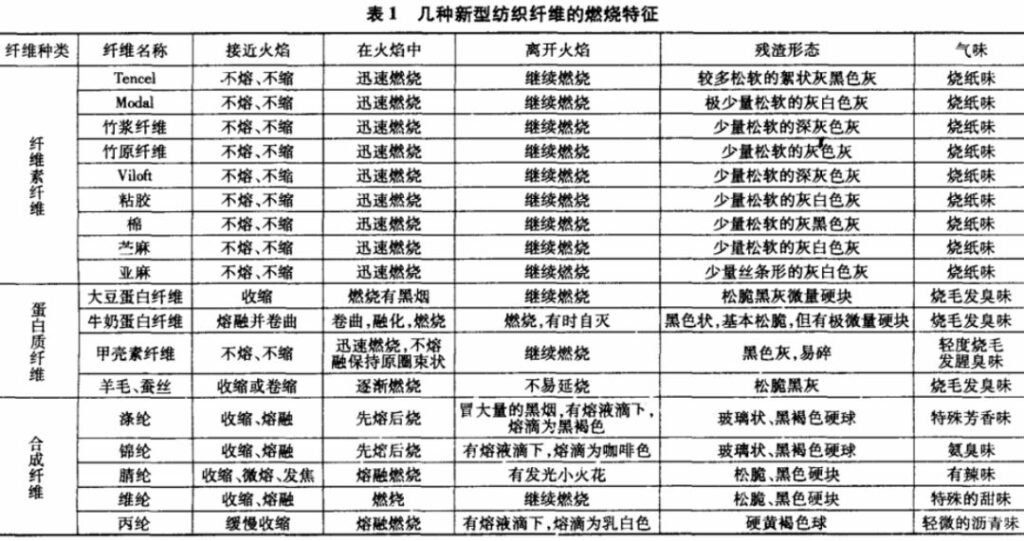
Image note: The featured reference table compares selected fibers by behavior near and during a flame, after removal, and in their residue and odor. Its original labels are Chinese; the English summary below names broad fiber groups and explains the limits. It is not a burn-test recipe.
Textile fiber burn test: common observations and limits
| Fiber family | Possible observation | Key limitation |
|---|---|---|
| Cellulosic fibers, such as cotton and linen | Often continue burning and leave relatively soft ash | Regenerated cellulose and treated fabrics may behave differently in practice |
| Protein fibers, such as wool and silk | May shrink from flame and produce a hair-like odor | Odor is subjective and should never be used as the sole identification method |
| Thermoplastic synthetics, such as polyester and nylon | May soften, melt or form a hard residue | Different polymers behave differently; blends complicate observations |
Why burn tests can give misleading results
- Blended fibers: Cotton/polyester and other blends can show more than one behavior.
- Dyes and finishes: Chemicals applied during processing can affect burning, odor and residue.
- Specialty or modified fibers: Regenerated and engineered fibers do not always follow simple family-level rules.
- Human observation: Flame, airflow, sample size and interpretation can change the apparent result.
A safer and more reliable workflow
- Check the supplier specification and traceable lot information.
- Use visual inspection only to form a preliminary hypothesis.
- Ask a qualified laboratory to select a validated method for the claimed composition.
- For blends, request a method that can identify and, where required, quantify the individual components.
- Keep the report with the purchase order and approved sample.
Safety first
Do not burn fabric at home, in an office or near stored textiles. If a burn test is part of an approved laboratory procedure, it must be conducted by trained staff with suitable ventilation, fire controls and protective equipment. Avoid directly inhaling smoke or deliberately smelling combustion products.
Buyer takeaway: A burn test may help distinguish broad fiber families, but it cannot reliably prove that a fabric is a specific specialty fiber or verify a blend ratio. Use laboratory confirmation for important purchasing or compliance decisions. For commercial fabric sourcing, review our woven fabric categories or contact our team with your specification.