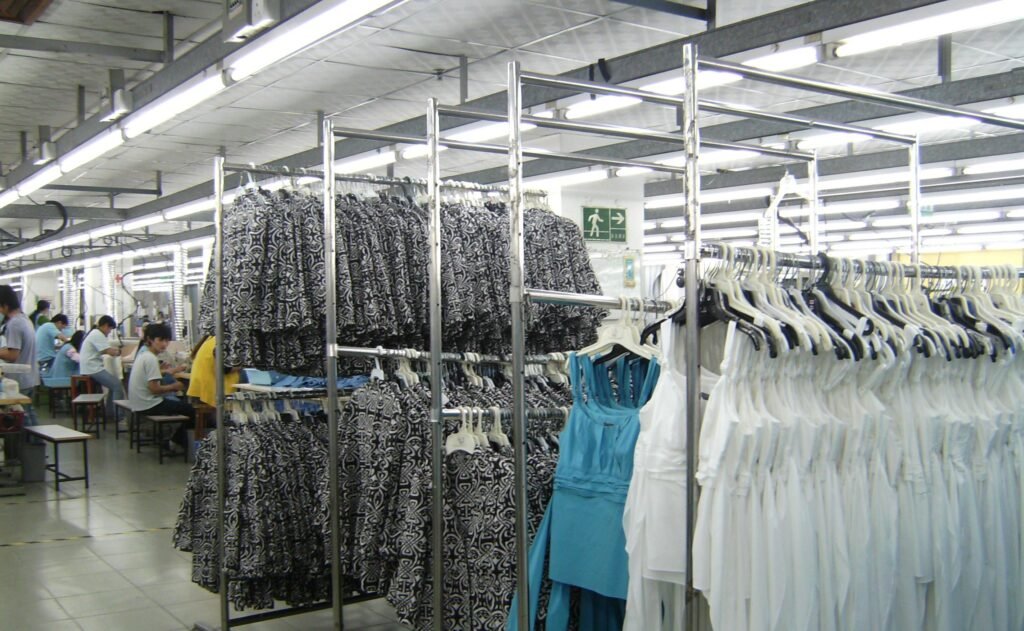

Fabric width affects marker efficiency, garment yield, and cutting-room planning. A roll may have a nominal width on its specification, while the usable or cuttable width is smaller after selvages, defects, or edge conditions are considered.
Why a width report may not match the cutting-room result
| Cause | What can differ | Control to agree |
|---|---|---|
| Fabric tension or relaxation | A stretched fabric may read wider than the same fabric measured relaxed. | State whether the fabric must be tension-free and relaxed before measurement. |
| Selvedge treatment | One report may include the selvedges while the marker excludes them. | Report edge-to-edge width and usable width separately; define the excluded zones. |
| Position along the roll | Width can vary from head to middle to tail. | Record the roll position for every reading and agree the sampling plan. |
| Finishing stage | Greige, dyed and finished fabric may not have the same width. | Identify the exact process stage at which the guaranteed width applies. |
Measurement standards and what they do not decide
ISO 22198:2006 covers fabric width and length measurement in a tension-free, relaxed state; ISO records it as current after its 2023 review. It does not assess construction defects and is not applicable to coated fabrics.
ASTM D3774-18(2024) covers width and usable-width measurement for woven and knitted fabrics, with options for full rolls or bolts and short specimens. Unless otherwise specified, its measurements include selvedges. The purchase specification must therefore state whether the required usable or cuttable width excludes selvedges.
These standards provide measurement methods; they do not create a universal cuttable-width tolerance for every garment marker. The buyer and supplier must agree the minimum usable width, exclusions, finishing stage and sampling plan.
A practical roll-by-roll inspection plan
- Identify the fabric lot, roll number, construction, colour and finishing stage.
- Allow the fabric to reach the agreed relaxed measurement condition. Do not pull the fabric tight to obtain a wider reading.
- Confirm whether the record needs total width, usable width or both, and mark exactly which selvedge or edge zones are excluded.
- Use the agreed method and record each reading with its position on the roll. A buyer may choose head, middle and tail readings as an internal sampling plan; this is a practical example, not a mandatory sample count in ISO 22198 or ASTM D3774.
- Calculate the average and the minimum separately. Compare the minimum with the contractual minimum; an average must not hide a narrow section.
- Hold any roll with a sampled usable-width result below the agreed limit for review. Confirm whether more inspection or a marker trial is required before cutting.
Example inspection record and calculation
Illustrative readings only: one roll gives usable-width readings of 58.8 inches at the head, 58.7 inches at the middle and 58.6 inches at the tail.
| Position | Usable width |
|---|---|
| Head | 58.8 in |
| Middle | 58.7 in |
| Tail | 58.6 in |
Average = (58.8 + 58.7 + 58.6) ÷ 3 = 58.7 inches. Minimum = 58.6 inches. Range = 58.8 − 58.6 = 0.2 inch. If the agreed minimum is 58.5 inches, these three sampled readings are 0.1 inch above it. This does not prove every point along the roll meets the limit unless the agreed inspection plan supports that conclusion.
What to put on the inspection sheet
Record lot and roll IDs, date, measurement method, finishing stage, relaxation condition, selvedge rule, reading positions, total width, usable width, minimum, average, defects and disposition. Attach photographs for edge damage or distortion and keep the record with the roll traceability documents.
For the definition and RFQ wording of minimum cuttable width, see our cuttable width of fabric guide.
What the RFQ should specify
State the nominal width, minimum cuttable width, tolerance, units, selvedge rule, finishing stage and measurement method. If marker efficiency is critical, share the marker’s minimum usable-width requirement before bulk production. Retain roll-by-roll readings with the lot records and hold any roll below the agreed minimum for review before cutting.